

 Koszyk ofertowy



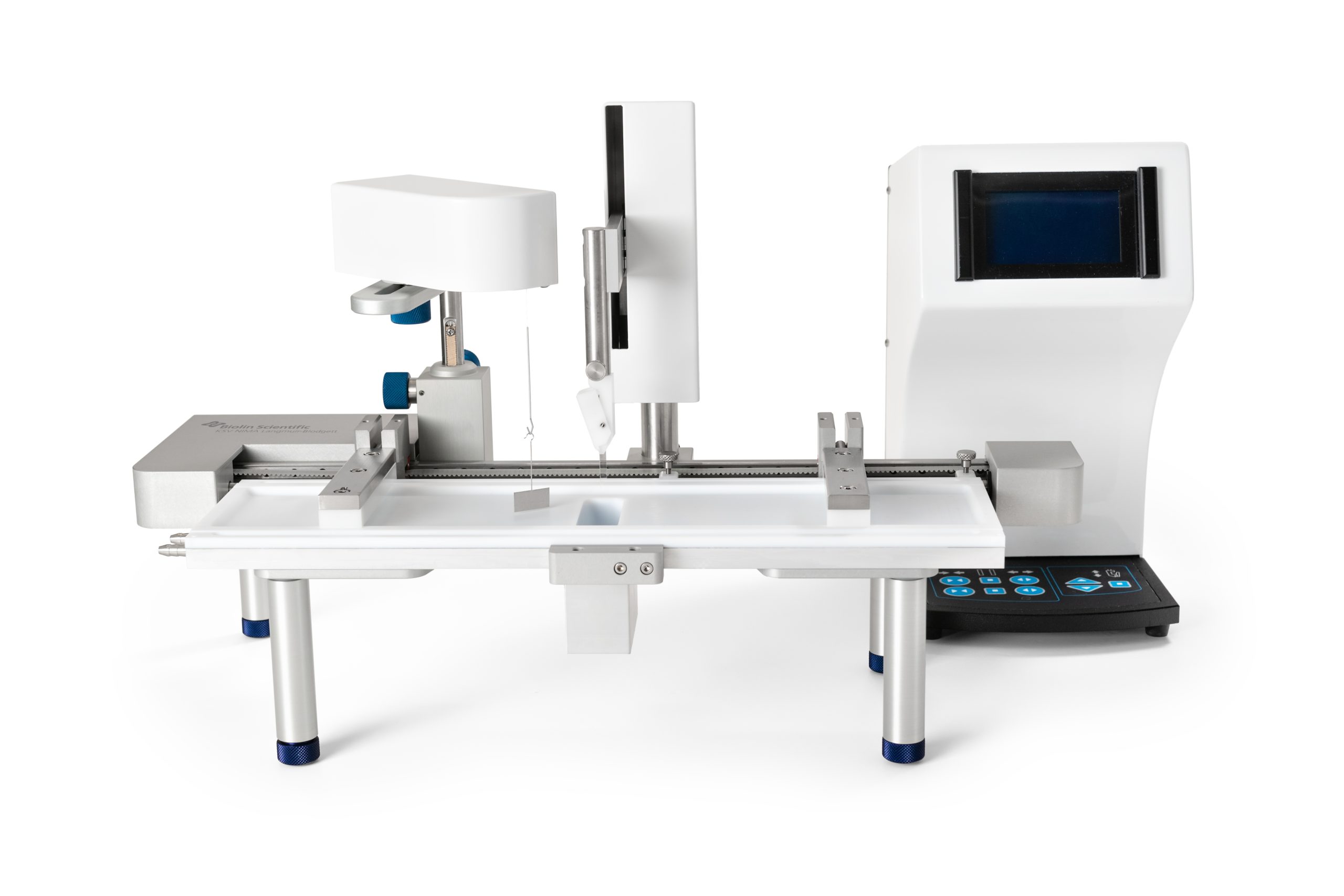
KSV NIMA Langmuir-Blodgett Medium
SKU: KN 2002
0,00 zloty
KN 2002 – KSV NIMA Langmuir-Blodgett Medium
Kompletny zestaw aparatu wyposażony w studzienkę zanurzeniową do wytwarzania filmów Langmuira oraz nanoszenia warstw metodą Langmuira–Blodgett, z komputerowo sterowaną wagą i napędem barier do standardowej analizy monowarstw na granicy faz powietrze–woda. Szczególnie rekomendowany do badań, w których cienkie warstwy osadzane są na stałym podłożu.
KN 2002 – KSV NIMA Langmuir-Blodgett Medium
Kompletny zestaw aparatu wyposażony w studzienkę zanurzeniową do wytwarzania filmów Langmuira oraz nanoszenia warstw metodą Langmuira–Blodgett, z komputerowo sterowaną wagą i napędem barier do standardowej analizy monowarstw na granicy faz powietrze–woda. Szczególnie rekomendowany do badań, w których cienkie warstwy osadzane są na stałym podłożu.
Zestaw zawiera:
1. Jednostka interfejsu z gotowymi do użycia złączami typu plug-in dla wszystkich modułów systemowych i akcesoriów
- Wbudowany wyświetlacz LCD do prezentacji w czasie rzeczywistym wartości ciśnienia powierzchniowego oraz położenia barier
- Membranowa, odporna na zalanie klawiatura do ręcznego sterowania barierami i mechanizmem zanurzającym (dipperem)
- Złącze USB do komputera PC
- Kontrola temperatury subfazy (w zestawie sonda temperatury i oprogramowanie; łaźnia sprzedawana oddzielnie)
- Interfejs dla elektrody pH (elektroda sprzedawana oddzielnie)
- Interfejs do mieszadła magnetycznego (mieszadło sprzedawane oddzielnie)
- Wejście analogowe do monitorowania zewnętrznego sygnału napięciowego (±10 V DC) podczas eksperymentu
2. Napęd barier z symetryczną kompresją realizowaną przez dwie sprzężone bariery powierzchniowe
- Wymiary: Dł. 483 × Szer. 227 × Wys. 293 mm
- Maksymalna prędkość barier: do 270 mm/min
- Rozdzielczość regulacji prędkości: 0,1 mm/min
3. Wysokoczuła waga z płytkami Wilhelmy’ego z platyny oraz papierowymi
(płytki wchodzą w skład zestawu startowego do monowarstw)
- Maksymalne obciążenie wagi: do 1 g
- Rozdzielczość pomiarowa: 0,03 µN/m
- Zakres pomiarowy: do 300 mN/m
4. Wanna (korytko) Langmuira-Blodgett
- Wykonana jako spiekany, pełny element z nieporowatego PTFE
- Powierzchnia: 273 cm² (Dł. 364 × Szer. 75 × Wys. 4 mm)
- Studzienka zanurzeniowa: (Dł. 20 × Szer. 56 × Wys. 60 mm)
- Maksymalny rozmiar próbki: Gr. 3 × Szer. 52 × Wys. 56 mm
- Całkowita objętość subfazy: 176 ml
- Możliwość szybkiego demontażu do czyszczenia lub wymiany na inne kompatybilne nakładki
5. Para hydrofilowych barier z Delrinu
6. Mechanizm zanurzający (Dipper) do w pełni automatycznej i sterowanej programowo depozycji filmów LB na podłożach stałych
- Montowany na oddzielnym statywie z regulacją wysokości
- Uchwyt (klips) na próbkę
- Maksymalny skok: 80 mm
- Regulowany zakres prędkości: 0,1 – 108 mm/min
7. Kompletny pakiet oprogramowania LB dla systemu Windows 10
8. Instrukcja obsługi (format PDF na nośniku USB)
9. Kompletny zestaw startowy do wykonania pierwszych eksperymentów ( KN 0053)
 Contact angle – What is it and how do you measure it?
Presentation of the operating principle of contact angle measurements.
Surface and interfacial tension - What is it and how to measure it?
Presentation of the operating principle of surface and interfacial tension measurements.
The Attension Theta Flex Optical Tensiometer with 3D Topography Module
Presentation of the capabilities of the Theta tensiometer with topography module.
Wetability Measurements for Enhanced Oil Recovery Optimization
Optimization of the oil recovery process based on wettability studies.
Wetability Measurements in Biomedical Applications
Presentation of the capabilities of Attension tensiometers in biomedical applications.
Adhesion How to Use Contact Angle Measurements to Predict Adhesion and Bonding?
Application of contact angle tests in adhesion measurements.
Using Attension Tensiometers to Evaluate Wetability in Li-ion Batteries
Use of Sigma tensiometers in the study of wettability of Li-Ion batteries.
Interfacial Rheology as Foam and Emulsion Stability Indicator
Emulsion stability testing using an optical tensiometer.
Interfacial Rheology as Foam and Emulsion Stability Indicator
Using the Theta tensiometer with the High pressure module to increase oil recovery using nanoparticles.
Influence of droplet volume on contact angle
Presentation of the effect of droplet volume on the measured contact angle.
Determination of the Optimal Plasma Treatment Time of Polypropylene
Influence of plasma exposure time on the surface properties of polypropylene.
Prove of Superior Coatings Quality with Dynamic Contact Angle
The influence of the coating on the surface properties determined by the dynamic contact angle measurement method.
Interfacial rheology of monolayers at the air-water interface
Presentation of the operation of the ISR module of the KSV-NIMA system on the example of measurements of viscoelastic properties at the water-air interface.
Reaching high monolayer surface pressures using a ribbon barrier trough: the case of near-zero surface tension pulmonary surfactants
Presentation of the use of a ribbon barrier trough to achieve high surface tensions (>70 mN/m).
Fabricating Highly Organized Nanoparticle Thin Films
Introduction to the principles of operation of the Langmuir and Langmuir-Blodgett systems and the preparation of highly organized monolayers.
Nanostrand Formation of Block Copolymers at the Air/Water Interface
Presentation of the preparation of monolayers in the form of copolymer structures using LB.
Brewster Angle Microscopy
Presentation of the operating principle and possibilities of imaging structures obtained in KSV-NIMA systems using the Brewster angle microscope.
Highly Controlled Nanoparticle Deposition using the Langmuir-Blodgett Method
Presentation of the possibilities of depositing monolayers of nanoparticles in KSV-NIMA systems.
What samples are suitable for contact angle testing using the topography module in Theta tensiometers? 

Topography measurements are suitable for samples with microscale roughness (analysis range of approximately 1–60 µm). Additionally, samples must be diffusive, i.e., opaque. Sample height is limited to 22 mm.
What droplet sizes can be produced using Theta tensiometers?
The minimum and maximum droplet size depends on the type of liquid and the needle used, as well as the substrate. The table below provides approximate values for water.
All volumes refer to drops suspended from the needle (except for the picoliter dispenser). This is because the amount of liquid transferred from the needle to the substrate depends on the surface area:
- if the substrate is highly hydrophilic, more liquid is transferred
- if it is highly hydrophobic, the amount of liquid on the surface may be less than in the needle
Please note that the values given are approximate and depend on the measuring system and environmental conditions.
| Dispenser type | Needle | Volume range | Type of measurements |
| Manual syringe Automatic single liquid dispenser |
14 G | 4 – 25 µl | ST, IT, (CA) |
| Manual syringe Automatic single liquid dispenser |
22 G | 1 – 18 µl | ST, IT, CA |
| Manual syringe Automatic single liquid dispenser |
30 G | 0.5 – 5 µl | CA |
| Pipette dispenser | Any ending | 2 – 15 µl | ST, IT, CA |
| Multi-liquid dispenser | 2 – 10 µl | CA, (ST) | |
| Picoliter dispenser | Depends on the ending | min. 20 pl, typically around 500 pl | CA |
What are the differences between using a Wilhelmy plate and a Du Noüy ring for measuring surface/interfacial tension in Sigma tensiometers?
When comparing the results obtained using the ring and plate methods, they may differ depending on the liquid—especially in surfactant solutions. This is due to differences in the measurement principle.
In the Wilhelmy plate method, the plate is stationary during the measurement, which means that the surfactant molecules have time to arrange themselves at the phase boundary, which lowers the surface tension value.
In the Du Noüy ring method, the interface is constantly changed as the ring moves during the measurement. Therefore, surface tension values are often slightly higher than those obtained using a plate. This effect can be observed even in water with minor impurities. For surfactant solutions, the Wilhelmy plate method is preferred.
| Du Noüy's Ring | Wilhelmy's plate | |
| Advantages | a more standardized and widely used method | no need to use correction factors and know the density |
| partially takes into account the evaporation of liquids | better suited for high viscosity liquids | |
| less susceptible to contamination | less susceptibility of the probe to deformation | |
| Defects | requires correction factors | a contact angle of 0° is assumed |
| greater susceptibility to deformation (bending) | the result depends on the height resolution of the measuring table | |
| it is necessary to know the density of both phases | more complex measurement of interfacial tension (effect of buoyancy force) | |
| possible meniscus rupture → interruption of measurement | greater susceptibility to plate contamination |
How to clean a Wilhelmy plate?
The plate should be rinsed with pure ethanol and water, then fired with a Bunsen burner (~1000°C). Too low a temperature can leave impurities that cause measurement errors. The plate should be heated red-hot in the hottest part of the flame, then removed before turning off the burner. Clean before and after use.
How to clean a Du Noüy ring?
The ring should be rinsed with ethanol and water and then fired with a Bunsen burner (~1000°C) as with the plate. Avoid low-temperature flames, as they can leave residue. The ring should be heated until red-hot and then removed before extinguishing the burner. Clean before and after use.
What samples are suitable for powder wettability testing?
The powder particle size must be larger than the pore size of the holder.
– Glass holder: 1 µm
– Steel handle (Sigma 700): 5 µm
The powder must not be soluble or react with the liquid
The powder contact angle should not exceed 90° (to allow the liquid to capillary uptake)
What is the viscosity range acceptable for testing using Sigma tensiometers?
There is no strict viscosity range because it also depends on the density, elasticity of the liquid, probe type and measurement parameters.
- up to approx. 1000 mPa s: usually measurements possible
- above 10,000 mPa s: mostly impossible
- intermediate range: requires compatibility testing
How to clean the density probe?
The probe should be rinsed with ethanol and distilled water. You can't use a Bunsen burner flame because the probe is not resistant to it.
How to perform a standard isothermal experiment with a liquid-liquid trough?
At the beginning of the liquid-liquid measurement, the heavy phase (water) is first poured into the trough.
We immerse the Wilhelmy liquid-liquid plate approximately halfway down its surface and check the cleanliness of the surface by squeezing it.
Next, carefully pour the lighter liquid onto the surface. It can be poured onto the step that expands at the liquid-liquid interface. Be careful not to pour it directly onto the heavy phase, as this can cause the phases to mix. The light phase liquid must be sufficient to cover the entire Wilhelmy plate, and the plate should not be immersed in air.
Open the barriers, zero the balance, and inject the material into the interface. Wait the appropriate time for the sample to stabilize at the interface, then begin measurement as usual.
For detailed instructions on standard measurement, please refer to the LB user manual and the Monolayer kit manual.
How to clean the trough and barriers?
The trough and barriers are made of Teflon and Delrin. The standard trough is made of Teflon, and the standard barriers are made of Delrin. If you're unsure whether you have a standard system, you can test the materials by placing a drop of water on both the trough and barriers. The drop will have a high contact angle on the Teflon and a low contact angle on the Delrin.
Always wear rubber gloves when handling these components. Remove the trough and barriers and wash them over the sink. Using a soft brush, cover the entire surface with pure ethanol, then rinse with clean, deionized water.
Delrin, from which the barriers are made, I don't tolerate Chloroform, but chloroform or other cleaning agents can be used to clean the Teflon trough. If a long time has passed since the trough was last used, it is worth first washing it with a commercially available detergent.