

 Koszyk ofertowy



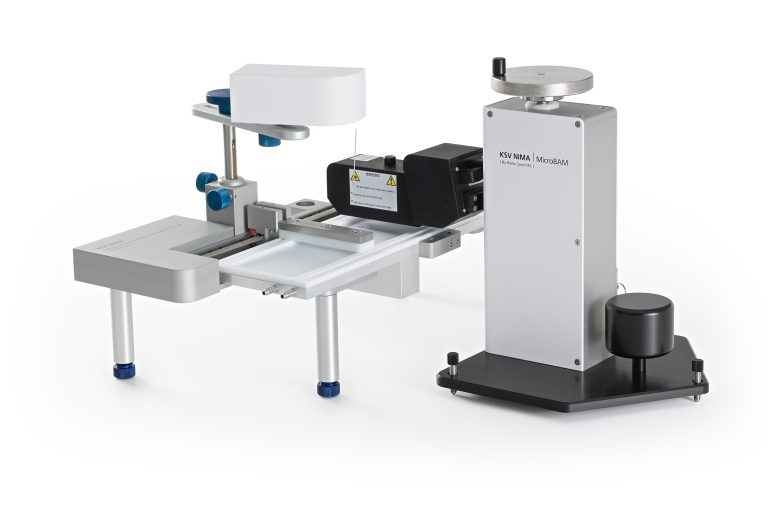
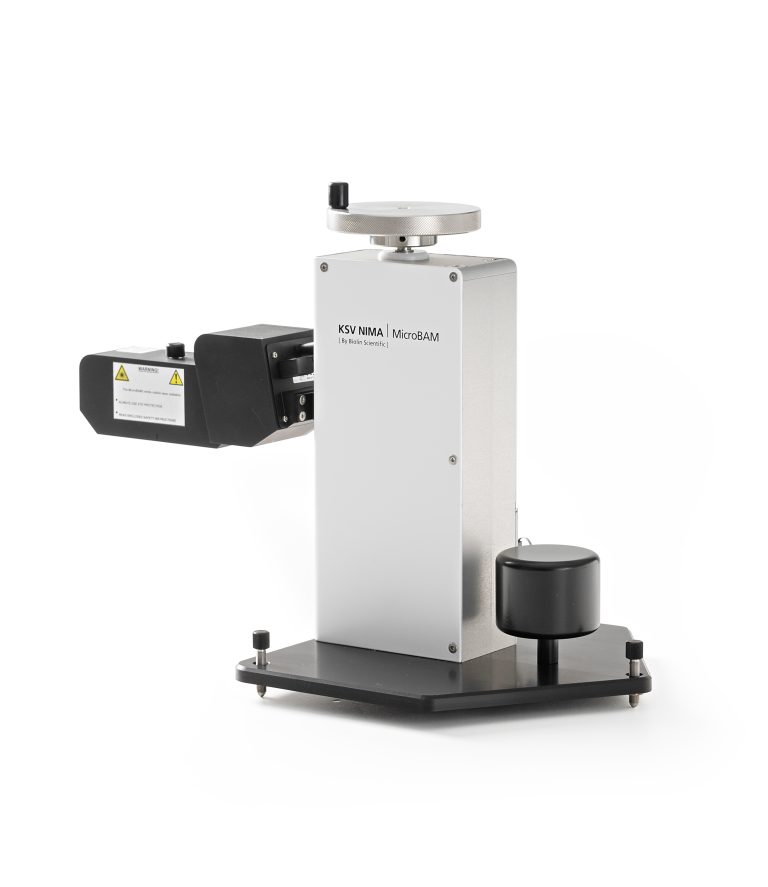

KSV NIMA MicroBAM
SKU: KN SA MicroBAM
0,00 zloty
KN SA MicroBAM – KSV NIMA MicroBAM
Mikroskop kąta Brewstera umożliwia obserwację pojedynczych warstw, zwykle na granicy faz woda-powietrze z wykorzytaniem wanny Langmuira. Mikroskop tworzy obraz powierzchni poprzez rejestrację zmian współczynnika załamania światła od powierzchni wody, w obecności cząsteczek środków powierzchniowo czynnych. Dostarcza informacji na temat jednorodności warstwy/filmu, jego zachowania i morfologii.
Areas of application:
Mikroskop Kąta Brewstera umożliwia wizualizację monowarstw Langmuira bądź monowarstw substancji zaadsorbowanych na granicy faz woda/powietrze. W połączeniu z wanną Langmuira pozwala na pomiary:
– Zachowania monowarstw, cienkich warstw (przemian fazowych, rozdzielania faz, kształtu cząstek, upakowania)
– Jednorodności monowarstwy, cienkiej warstwy (z wykorzystaniem Wanny Langmuira i LB możliwa jest obserwacja zachowania warstwy podczas kompresji/ekspansji przy znanym napięciu powierzchniowym)
– Oddziaływań subfazy na strukturę warstwy powierzchniowej (obserwacja zmiany monowarstwy przy zmianie charakteru subfazy)
– Reakcji powierzchniowych (reakcji fotochemicznych, reakcji polimeryzacji czy tez reakcji enzymatycznych w czasie rzeczywistym)
– Detekcję czynnych powierzchniowo materiałów.
KN SA MicroBAM – KSV NIMA MicroBAM
Mikroskop kąta Brewstera umożliwia obserwację pojedynczych warstw, zwykle na granicy faz woda-powietrze z wykorzytaniem wanny Langmuira. Mikroskop tworzy obraz powierzchni poprzez rejestrację zmian współczynnika załamania światła od powierzchni wody, w obecności cząsteczek środków powierzchniowo czynnych. Dostarcza informacji na temat jednorodności warstwy/filmu, jego zachowania i morfologii.
Areas of application:
Mikroskop Kąta Brewstera umożliwia wizualizację monowarstw Langmuira bądź monowarstw substancji zaadsorbowanych na granicy faz woda/powietrze. W połączeniu z wanną Langmuira pozwala na pomiary:
– Zachowania monowarstw, cienkich warstw (przemian fazowych, rozdzielania faz, kształtu cząstek, upakowania)
– Jednorodności monowarstwy, cienkiej warstwy (z wykorzystaniem Wanny Langmuira i LB możliwa jest obserwacja zachowania warstwy podczas kompresji/ekspansji przy znanym napięciu powierzchniowym)
– Oddziaływań subfazy na strukturę warstwy powierzchniowej (obserwacja zmiany monowarstwy przy zmianie charakteru subfazy)
– Reakcji powierzchniowych (reakcji fotochemicznych, reakcji polimeryzacji czy tez reakcji enzymatycznych w czasie rzeczywistym)
– Detekcję czynnych powierzchniowo materiałów.
BAM został pierwotnie zaprojektowany do badania oddziaływań na granicy powietrze-woda, ale dla konkretnych warunków może być użyty do obserwacji na granicy faz powietrze-szkło.
Zasada działania:
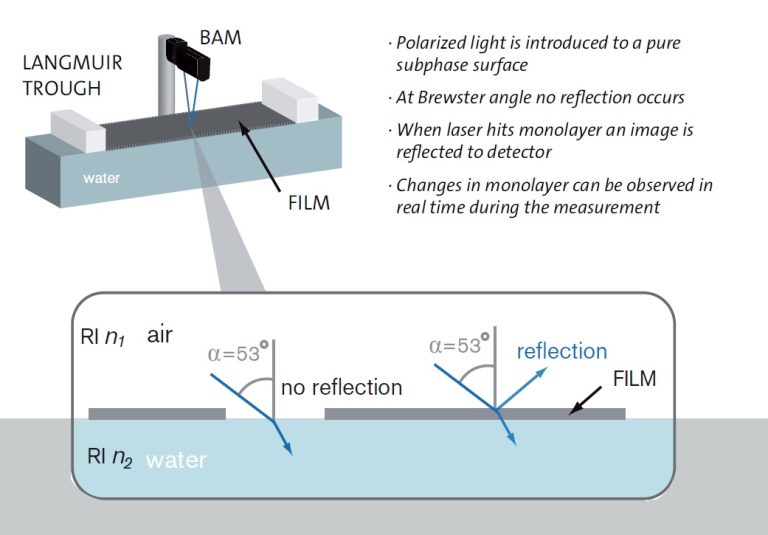
Mikroskop Kąta Brewstera wykorzystuje fakt że gdy p-spolaryzowane światło przechodzi przez granicę faz powietrze-woda, brak odbicia zachodzi tylko pod określonym kontem padania. Ten kąt, kąt Brewstera, jest określona przez prawo Snella i zależy od współczynników załamania materiałów w układzie
Prawo Shnella: tan α = n2 / n1.
gdzie α-kąt Brewstera w radianach,n1-współczynnik załamania światła powietrza (ok.1), n2-współczynnik załamania światła wody (ok. 1.33)
Wartość Kata Brewstera dla granicy faz powietrze-woda wynosi 53°, w takich warunkach zdjęcie powierzchni czystej wody będzie czarne. Dodanie substancji tworzącej warstwę na granicy faz powietrze-woda powoduje lokalną zmianę współczynnika załamania światła wody, w tym wypadku pewna część światła podlega odbiciu od powierzchni i tworzy obraz w mikroskopie. Wyświetlany obraz zawiera obszary o różnej jasności, określanej przez ilość poszczególnych cząsteczek i gęstość ich upakowania na całym obszarze próbkowania.
KSV NIMA MicroBAM jest łatwym w użyciu narzędziem do nieinwazyjnego obrazowania pojedynczych warstw na granicy faz powietrze-woda. Doskonała jakość obrazu i dobra rozdzielczość lateralna są wystarczające dla większości zastosowań i charakteryzacji własności powierzchniowych/warstwowych. Obserwacja w czasie rzeczywistym i zapis struktury cienkiego filmu umożliwia obserwację procesów dynamicznych. KSV NIMA MicroBAM może być używany z większością wanien Langmuira i Langmuira-Blodgett KSV NIMA, czyli Średnimi, Dużymi i Wysokiej Kompresji. MicroBAM i wanna Langmuira mogą być połączone, aby umożliwić automatyczne pomiary obrazu w zależności od ciśnienia w czasie lub na powierzchni. Urządzenie może być ustawione ręcznie: poziomowanie oraz regulacja wysokości napędu głowicy pomiarowej.
KSV NIMA MicroBAM musi być używany razem z wanną Langmuira lub Langmuir-Blodgett, umożliwia rejestrację, regulację obrazu i eksport. Może być używany z dowolnym komputerem posiadającym port USB.
Zalety produktu:
– rozdzielczość rzędu (12µm) odpowiednia dla większości aplikacji
– kompaktowe urządzenie o mniejszych rozmiarach
– podgląd próbek w czasie rzeczywistym
– ekonomiczny wybór z nowoczesnym oprogramowaniem
– łatwy w użyciu i przygotowaniu instrument
– kompatybilny w większością wanien Langmuira i Langmuir-Blodgett
materiały dodatkowe: Inspect the Quality of the Floating Langmuir Layer
Tabela specyfikacji technicznej
| KSV NIMA MicroBAM | |
| Kąt padania światła (*) | 53, ustawiony |
| Moc źródła światła (mW) | 50 |
| Długość światła źródła (nm) | 659 |
| Rozdzielczość obrazu (µm) | 12 (w poziomie obrazu)
zgodnie z kryteriami Rayleigha |
| Pole widzenia (µm) | 600 x 4 000 |
| Polaryzator | Ustawiony p-polaryzator światła padającego |
| Analizator | Ustawiony |
| Kamera | Kamera USB o rozdzielczości 640-480 i prędkości nagrywania 30 klatek/s, regulowany czas ekspozycji i wzmocnienia |
| System przetwarzania obrazu | Różne dedykowane funkcje przetwarzania obrazu: zmiana rozmiaru, profilu kontrasu, filtrowanie, określanie wielkości cząstek |
| Wymiary (H x L x W, cm) | Instrument: 40,2 x 22 x 27,7 Głowica pomiarowa: 7.2 x 5.7 x 16.2 |
| Zasilanie | 100-240 V, 50/60 Hz. |
| Kompatybilność z Wannami L i LB | KSV NIMA L i LB modele Sredni, Duży i Wysokiej Kompresji |
| Masa(kg) | 10 |
Zestaw zawiera:
- Statyw do optymalnego, ręcznego pozycjonowania jednostki obrazującej
- Moduł głowicy kamery i lasera
- Sprzętową blokadą bezpieczeństwa (interlock) z kluczem
- Czarną szklaną płytą do eliminacji zakłóceń światłem rozproszonym
- Kablem USB (komunikacja oraz zasilanie głowicy laserowej i detektora optycznego)
- Elementem przedłużającym (70 mm) do głowicy pomiarowej z dodatkowym obciążnikiem (1 kg)
- Pełną kompatybilnością z oprogramowaniem KSV NIMA Langmuir-Blodgett, umożliwiającą regulację wysokości sterowaną programowo
- Instrukcję obsługi
- Oprogramowaniem
 Contact angle – What is it and how do you measure it?
Presentation of the operating principle of contact angle measurements.
Surface and interfacial tension - What is it and how to measure it?
Presentation of the operating principle of surface and interfacial tension measurements.
The Attension Theta Flex Optical Tensiometer with 3D Topography Module
Presentation of the capabilities of the Theta tensiometer with topography module.
Wetability Measurements for Enhanced Oil Recovery Optimization
Optimization of the oil recovery process based on wettability studies.
Wetability Measurements in Biomedical Applications
Presentation of the capabilities of Attension tensiometers in biomedical applications.
Adhesion How to Use Contact Angle Measurements to Predict Adhesion and Bonding?
Application of contact angle tests in adhesion measurements.
Using Attension Tensiometers to Evaluate Wetability in Li-ion Batteries
Use of Sigma tensiometers in the study of wettability of Li-Ion batteries.
Interfacial Rheology as Foam and Emulsion Stability Indicator
Emulsion stability testing using an optical tensiometer.
Interfacial Rheology as Foam and Emulsion Stability Indicator
Using the Theta tensiometer with the High pressure module to increase oil recovery using nanoparticles.
Influence of droplet volume on contact angle
Presentation of the effect of droplet volume on the measured contact angle.
Determination of the Optimal Plasma Treatment Time of Polypropylene
Influence of plasma exposure time on the surface properties of polypropylene.
Prove of Superior Coatings Quality with Dynamic Contact Angle
The influence of the coating on the surface properties determined by the dynamic contact angle measurement method.
Interfacial rheology of monolayers at the air-water interface
Presentation of the operation of the ISR module of the KSV-NIMA system on the example of measurements of viscoelastic properties at the water-air interface.
Reaching high monolayer surface pressures using a ribbon barrier trough: the case of near-zero surface tension pulmonary surfactants
Presentation of the use of a ribbon barrier trough to achieve high surface tensions (>70 mN/m).
Fabricating Highly Organized Nanoparticle Thin Films
Introduction to the principles of operation of the Langmuir and Langmuir-Blodgett systems and the preparation of highly organized monolayers.
Nanostrand Formation of Block Copolymers at the Air/Water Interface
Presentation of the preparation of monolayers in the form of copolymer structures using LB.
Brewster Angle Microscopy
Presentation of the operating principle and possibilities of imaging structures obtained in KSV-NIMA systems using the Brewster angle microscope.
Highly Controlled Nanoparticle Deposition using the Langmuir-Blodgett Method
Presentation of the possibilities of depositing monolayers of nanoparticles in KSV-NIMA systems.
What samples are suitable for contact angle testing using the topography module in Theta tensiometers? 

Topography measurements are suitable for samples with microscale roughness (analysis range of approximately 1–60 µm). Additionally, samples must be diffusive, i.e., opaque. Sample height is limited to 22 mm.
What droplet sizes can be produced using Theta tensiometers?
The minimum and maximum droplet size depends on the type of liquid and the needle used, as well as the substrate. The table below provides approximate values for water.
All volumes refer to drops suspended from the needle (except for the picoliter dispenser). This is because the amount of liquid transferred from the needle to the substrate depends on the surface area:
- if the substrate is highly hydrophilic, more liquid is transferred
- if it is highly hydrophobic, the amount of liquid on the surface may be less than in the needle
Please note that the values given are approximate and depend on the measuring system and environmental conditions.
| Dispenser type | Needle | Volume range | Type of measurements |
| Manual syringe Automatic single liquid dispenser |
14 G | 4 – 25 µl | ST, IT, (CA) |
| Manual syringe Automatic single liquid dispenser |
22 G | 1 – 18 µl | ST, IT, CA |
| Manual syringe Automatic single liquid dispenser |
30 G | 0.5 – 5 µl | CA |
| Pipette dispenser | Any ending | 2 – 15 µl | ST, IT, CA |
| Multi-liquid dispenser | 2 – 10 µl | CA, (ST) | |
| Picoliter dispenser | Depends on the ending | min. 20 pl, typically around 500 pl | CA |
What are the differences between using a Wilhelmy plate and a Du Noüy ring for measuring surface/interfacial tension in Sigma tensiometers?
When comparing the results obtained using the ring and plate methods, they may differ depending on the liquid—especially in surfactant solutions. This is due to differences in the measurement principle.
In the Wilhelmy plate method, the plate is stationary during the measurement, which means that the surfactant molecules have time to arrange themselves at the phase boundary, which lowers the surface tension value.
In the Du Noüy ring method, the interface is constantly changed as the ring moves during the measurement. Therefore, surface tension values are often slightly higher than those obtained using a plate. This effect can be observed even in water with minor impurities. For surfactant solutions, the Wilhelmy plate method is preferred.
| Du Noüy's Ring | Wilhelmy's plate | |
| Advantages | a more standardized and widely used method | no need to use correction factors and know the density |
| partially takes into account the evaporation of liquids | better suited for high viscosity liquids | |
| less susceptible to contamination | less susceptibility of the probe to deformation | |
| Defects | requires correction factors | a contact angle of 0° is assumed |
| greater susceptibility to deformation (bending) | the result depends on the height resolution of the measuring table | |
| it is necessary to know the density of both phases | more complex measurement of interfacial tension (effect of buoyancy force) | |
| possible meniscus rupture → interruption of measurement | greater susceptibility to plate contamination |
How to clean a Wilhelmy plate?
The plate should be rinsed with pure ethanol and water, then fired with a Bunsen burner (~1000°C). Too low a temperature can leave impurities that cause measurement errors. The plate should be heated red-hot in the hottest part of the flame, then removed before turning off the burner. Clean before and after use.
How to clean a Du Noüy ring?
The ring should be rinsed with ethanol and water and then fired with a Bunsen burner (~1000°C) as with the plate. Avoid low-temperature flames, as they can leave residue. The ring should be heated until red-hot and then removed before extinguishing the burner. Clean before and after use.
What samples are suitable for powder wettability testing?
The powder particle size must be larger than the pore size of the holder.
– Glass holder: 1 µm
– Steel handle (Sigma 700): 5 µm
The powder must not be soluble or react with the liquid
The powder contact angle should not exceed 90° (to allow the liquid to capillary uptake)
What is the viscosity range acceptable for testing using Sigma tensiometers?
There is no strict viscosity range because it also depends on the density, elasticity of the liquid, probe type and measurement parameters.
- up to approx. 1000 mPa s: usually measurements possible
- above 10,000 mPa s: mostly impossible
- intermediate range: requires compatibility testing
How to clean the density probe?
The probe should be rinsed with ethanol and distilled water. You can't use a Bunsen burner flame because the probe is not resistant to it.
How to perform a standard isothermal experiment with a liquid-liquid trough?
At the beginning of the liquid-liquid measurement, the heavy phase (water) is first poured into the trough.
We immerse the Wilhelmy liquid-liquid plate approximately halfway down its surface and check the cleanliness of the surface by squeezing it.
Next, carefully pour the lighter liquid onto the surface. It can be poured onto the step that expands at the liquid-liquid interface. Be careful not to pour it directly onto the heavy phase, as this can cause the phases to mix. The light phase liquid must be sufficient to cover the entire Wilhelmy plate, and the plate should not be immersed in air.
Open the barriers, zero the balance, and inject the material into the interface. Wait the appropriate time for the sample to stabilize at the interface, then begin measurement as usual.
For detailed instructions on standard measurement, please refer to the LB user manual and the Monolayer kit manual.
How to clean the trough and barriers?
The trough and barriers are made of Teflon and Delrin. The standard trough is made of Teflon, and the standard barriers are made of Delrin. If you're unsure whether you have a standard system, you can test the materials by placing a drop of water on both the trough and barriers. The drop will have a high contact angle on the Teflon and a low contact angle on the Delrin.
Always wear rubber gloves when handling these components. Remove the trough and barriers and wash them over the sink. Using a soft brush, cover the entire surface with pure ethanol, then rinse with clean, deionized water.
Delrin, from which the barriers are made, I don't tolerate Chloroform, but chloroform or other cleaning agents can be used to clean the Teflon trough. If a long time has passed since the trough was last used, it is worth first washing it with a commercially available detergent.