
 Koszyk ofertowy


 Products
Surface plasmon resonance
L-SPR Insplorion
przyrządy L-SPR
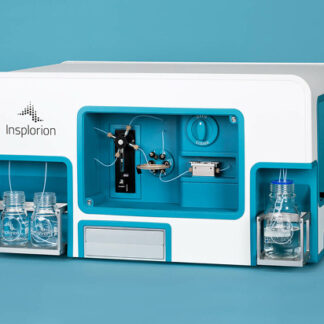
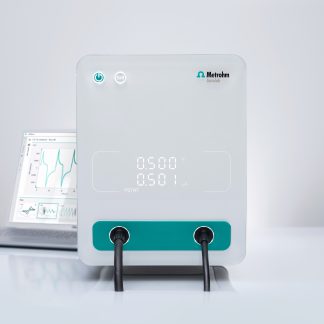
Insplorion X1 (Optics unit single channel, X1 Temperature control unit, High Temperature Measurement chamber, Insplorer software)
Products
Surface plasmon resonance
L-SPR Insplorion
przyrządy L-SPR
Insplorion X1 (Optics unit single channel, X1 Temperature control unit, High Temperature Measurement chamber, Insplorer software)

Insplorion X1 (Optics unit single channel, X1 Temperature control unit, High Temperature Measurement chamber, Insplorer software)
SKU: X1
0,00 zloty
Insplorion X1
Instrument Insplorion X1 został opracowany do badania procesów adsorpcji/absorpcji gazów i innych interakcji materiałowych, a także przemian fazowych (np. Tg) w cienkich warstwach polimerowych i materiałach istotnych dla katalizy in situ i w czasie rzeczywistym od temperatury otoczenia do 600°C.
Kluczowe cechy
X1 mierzy zmiany strukturalne i/lub dielektryczne praktycznie dowolnego nanomateriału lub cienkiej warstwy, zarówno dielektrycznej, jak i metalicznej, indukowane m.in. składem gazu lub rampami temperatury. Insplorion X1 wykorzystuje zdalny odczyt optyczny, dzięki czemu tylko chip czujnika musi być umieszczony w komorze reakcyjnej.
Ultraczułe pomiary w nanoskali
Monitoruj dynamiczne procesy w/na nanocząstkach, nanostrukturach lub cienkich warstwach, w skali nanometrowej, dziesiątkach nanometrów lub na ukrytym wewnętrznym interfejsie grubych powłok.
Zintegrowana kontrola przepływu gazu
System X1 można skonfigurować do współpracy z maksymalnie 16 kontrolerami przepływu masowego w celu precyzyjnej i terminowej kontroli mieszanki gazów i przepływu.
Analiza w czasie rzeczywistym
Mierz z rozdzielczością czasową poniżej sekundy.
Łatwy i solidny
Szybko rozpocznij pracę z oprogramowaniem Insplorer, które oferuje pełną kontrolę nad instrumentem.
Pomiary in-situ
Mierz w praktycznie odpowiednich warunkach w temperaturach do 600˚C.
System podwójnej próbki
Mierz jednocześnie na maksymalnie dwóch próbkach.
Komora pomiarowa
| Parametr | Specyfikacja |
|---|---|
| Pozycja chipa sensora | Pojedynczy lub podwójny kanał |
| Przyłącza | Wlot 1/8 cala, wylot 1/4 cala |
| Regulacja przepływu masowego* | Możliwość podłączenia do 16 regulatorów przepływu masowego (MFC) |
| Materiały | Kwarc, stal nierdzewna |
| Zakres temperatury | Od temperatury pokojowej do 600°C |
* Nie zawiera w zestawie. Oprogramowanie Insplorer kompatybilne z regulatorami przepływu masowego firmy Bronkhorst.
Sensory
| Parametr | Specyfikacja |
|---|---|
| Wymiary | 9,5 × 9,5 mm, grubość 1 mm |
| Podłoże | Szkło kwarcowe (fused silica) |
| Powierzchnia | Nanostrukturyzowane złoto |
| Standardowe powłoki* | Au, SiO₂, Al₂O₃, TiO₂ |
* Możliwość zamówienia sensorów z niestandardowymi cienkimi powłokami.
Charakterystyka pomiarowa
| Parametr | Specyfikacja |
|---|---|
| Źródło światła* | Lampa wolframowo-halogenowa, min. żywotność 2000 h |
| Średnica plamki pomiarowej | 2 mm |
| Rozdzielczość czasowa** | Do 10 punktów pomiarowych/s |
| Typowy poziom szumu | < 0,01 nm (długość fali) |
| Zakres długości fali*** | 450–1000 nm |
* Dostępne opcje niestandardowe i części zamienne.
** Przy częstotliwości próbkowania 1 Hz.
*** Dostępne niestandardowe zakresy długości fali.
Wymiary (szer. × gł. × wys.)
| Parametr | Specyfikacja |
|---|---|
| Reaktor wysokotemperaturowy z osłoną bezpieczeństwa | 28 × 28 × 100 cm |
| Jednostka optyczna Insplorion | 25 × 27 × 9 cm |
| Jednostka kontroli temperatury (2 elementy) | 25 × 27 × 9 cm oraz 22 × 40 × 9 cm |
Oprogramowanie
| Parametr | Specyfikacja |
|---|---|
| Kompatybilne oprogramowanie | Insplorer |
| System operacyjny | Kompatybilny z Microsoft Windows |
| Format danych wyjściowych | ASCII (kompatybilny z dowolnym oprogramowaniem do tworzenia wykresów) |
| Analizowane parametry | Odczyt wieloparametrowy (np. długość fali rezonansowej i ekstynkcja w maksimum LSPR) |
Insplorion offers access to a large number of application notes describing the applications of nanoplasmonic detection systems in various research fields. Below, we present a selection of application notes covering various types of plasmon resonance research. To view all available application notes, please visit the website. Insplorion.
 NanoPlasmonic Sensing
Presentation of the NanoPlasmonic Sensing technique and an overview of applications.
NPS applications: Lipids
Presentation of the application of NanoPlasmonic Sensing in lipid research.
NPS for surface adsorption behavior of proteins
Summary of 3 publications using NPS for protein adsorption studies.
Hydrogen Storage in Palladium Nanoparticles - Thermodynamics
Study of the thermodynamics of hydrogen layer on SiO2 before deposition of Pd nanoparticles on the Pd nanoparticle surface using the indirect nanoplasmonic detection (INPS) technique.
Hydrogen Storage in Palladium Nanoparticles - Size Dependent Kinetics
Study of storage stability and hydrogen transport kinetics using INPS.
Optical Nanocalorimetry of Catalytic Reactions
Using INPS to monitor local temperature changes on nanoparticle catalysts.
Nanoparticle Sintering
Using INPS technique on Pt/SiO2 catalysts to monitor catalyst sintering and damage in real time.
Nanoplasmonic Sensing of Dye Diffusion in Mesoporous TiO2
Using LSPR to study the kinetic and quantitative properties of molecular permeation in solar cells (DSSC).
Confinement Effect on the Glass Transition Temperature in Thin Polymer Films
NPS technology was used to measure the effect of confinement on the glass transition temperature (Tg) in thin polymer films and polymer composites.
Soft Matter Adsorption 1: Kinetics of Lipid Vesicle Attachment and Deformation
Use of NPS for quantitative study of lipid vesicle adsorption kinetics.
Soft Matter Adsorption 2: Controlling Membrane Architecture
Monitoring lipid membranes on Insplorion sensors with different substrates.
Photoswitching in Azobenzene-Functionalized Self-Assembled Monolayers on Au
Acquisition of quantitative data on light-induced trans-cis and cis-trans processes as a function of irradiation intensity.
Determination of Qst for CO2 adsorption in a microporous polymer
Using NPS technology to monitor the adsorption of CO2 molecules on polymer.
Real-time monitoring of nematic-isotropic phase transition in liquid crystal films
Application of NPS in monitoring first-order transitions from nematic to isotropic phase in liquid crystal layers
Capture and sensing of virus-like particles in plasmonic nanoholes
Insplorion XNano II was used to analyze spectral changes during the capture of virus-like particles on a gold sensor with nanoholes.
Gas adsorption studies using Surface-Anchored Metal-Organic Frameworks and Nanoplasmonic Sensing
Using NPS to monitor gas adsorption on a surface-anchored metal-organic framework (SURMOF).
Location specific sensing in Plasmonic Nanowells
This note presents how nanostructured plasmonic substrates can provide a way to obtain a sensor with specific detection properties.
Dye Molecule Interactions with Flat Dye Sensitized Solar Cell TiO2 Photoelectrode Mimics
Using indirect nanoplasmonic sensing (INPS) to study the adsorption of dye molecules on flat, thin (12–70 nm) and dense (i.e. non-porous) TiO2 layers.
Sintering of platinum nanoparticle catalysts in mesoporous aluminasupport
Study of catalytic processes on a 3D matrix with catalyst nanoparticles.
Biomolecular interaction analysis using the Insplorion Acoulyte for combined NPS and QCM-D measurements
Lipid adsorption study in a combined NPS and QCD-D study.
Real-time in situ analysis of Nanoparticle Surface Interactions
The use of NPS and sensors mimicking dielectric nanoparticles for in situ monitoring of biocrown formation.
Analysis of interactions with hydrated films using the Insplorion Acoulyte for combined NPS and QCM-D measurements
Study of the dynamics of enzymatic hydrolysis of polyester films using NPS and QCM-D.
Peripheral membrane protein association with lipid bilayers using the Insplorion Acoulyte for combined NPS and QCM-D measurements
Combination of NPS and QCM-D techniques for studying the dynamics between lipid bilayers.
Advances in optical nanocalorimetry techniques for the characterization of thin films
NPS was used to evaluate the effect of layer thickness on the thermal stability of semi-crystalline, liquid crystal and glass-organic semiconductor layers.
Kinetic discrimination of DNA single base mutations by NPS
Using LSPR to distinguish between mono- and multi-stranded DNA structures by analyzing hybridization processes.
NPS allos the study of lipid phase transition temperature
Using LSPR to measure changes in the phase transition temperature of liposms.
Tracking adsorption and loading of target molecules into hydrogels
Using LSPR to track molecules as they adsorb into a hydrogel.
Investigating Ion-Protein Binding for Magnetite Formation Using NPS
Monitoring iron ion binding in magnetosome proteins and their mutations.
Antibody quantification and corresponding molecular hydratuin using Insplorion's NanoPlasmonic Sensing in combination with QCM-D
Using a combination of NPS and QCM-D to build an antibody biosensor in water.
Fiber optical detection of sodium plating in sodium-ion batteries
Using Insplorion optical sensors to track the progress of internal precipitation processes in sodium batteries.
Immobilization of proteins on NPS Epoxy sensors
Presentation of the capabilities of sensors with active epoxy groups for protein immobilization in the Insplorion S2 system.
Fiber optical detection from Lithium plating
Using Insplorion optical sensors to track the progress of internal precipitation processes in lithium batteries.